
Overview of the salinometer#
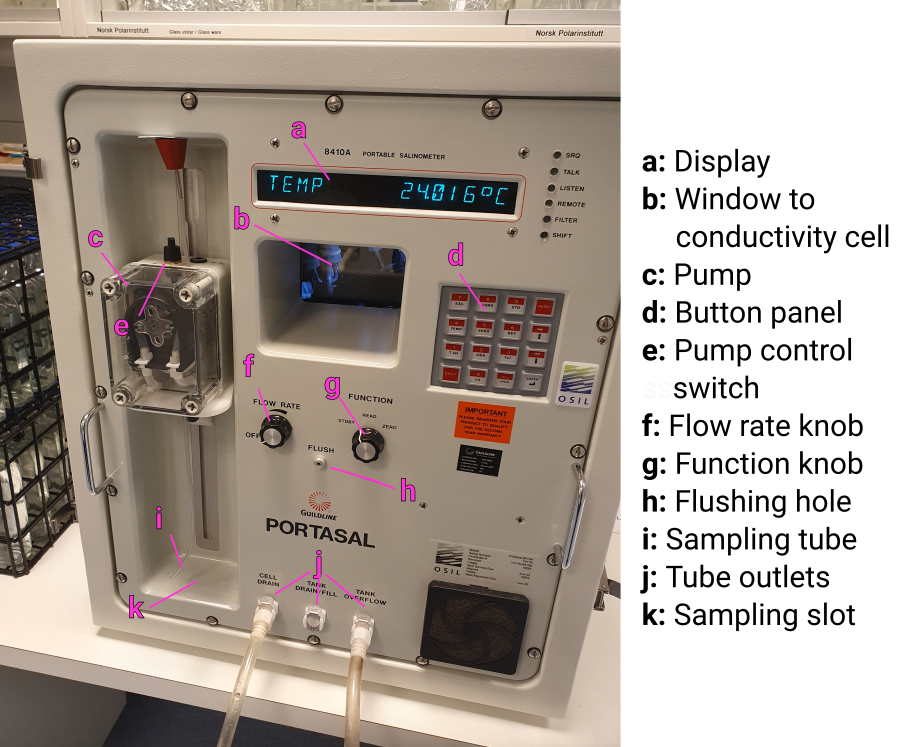
Front panel schematic#
Precision, bias and limit of determination#
The Guildline Portasal Model 8410A has a measurement range from 0.004 mS/cm to 76 mS/cm with a resolution of 0.0003 mS/cm.
The measurement can be made at a bath temperature selectable from 15°C to 38°C in steps of 1°C.
The accuracy of the instrument is better than 0.003 equivalent Practical Salinity Units.
Analytical procedure#
The sample conductivity ratio, \(R_t\), given from the salinometer is calculated as (from the manual, sections: 6.6.3.1-2):
where \(G\) is the conductivity of the sample, \(G_{STD}\) is the conductivity of the IAPSO standard seawater at 15ºC, and \(r_t\) is a correction factor based on the bath temperature set point, \(t\) (in centigrade):
The standard conductivity at 15ºC, \(G_{STD}\), is determined during standardization:
where \(G\) is the measured conductivity of the standard water, which is divided by the certified conductivity ratio (see label on IAPSO bottle), and finally corrected for the bath temperature, using \(r_t\) to give the equivalent conductivity of the standard seawater at 15ºC.
The manual recommends a standardization every 24 hrs, but samples can also be post-calibrated using measurements of standard seawater.
The instrument uses the PSS-78 algorithm for Practical Salinity to convert $R_t$ to salinity. This calculation is valid in the range 2 <
SP < 42. The analyser can choose to get readings as either conductivity ratios or as salinities. If the former is chosen,
gsw_SP_salinometer.m can be used calculate samples to salinities in MATLAB.